
The Problem with Traditional Presentation Tools
PowerPoint and Keynote are powerful — but they're not built for the modern way teams work. Collaboration requires emailing files back and forth. Version control is a manual nightmare. Design flexibility is limited by rigid slide templates. And they're locked behind expensive subscriptions.
CollabDraw's presentation mode flips this model. Presentations are built on the same infinite canvas as everything else, with full design freedom, real-time collaboration, and no subscription required.
Starting from a Template
CollabDraw includes 50+ professionally designed presentation templates across several categories:
- Business pitch decks — investor presentations with problem/solution/market/traction structure
- Product presentations — feature walkthroughs, launch announcements, roadmap reveals
- Marketing decks — campaign proposals, brand guidelines, strategy presentations
- Educational slides — lecture notes, course materials, tutorial walkthroughs
- Report presentations — quarterly reviews, annual reports, team performance summaries
- Minimalist / clean — typographic, whitespace-heavy slides for editorial and creative use
Each template loads as a set of editable canvas pages. Every element — title text, body copy, colours, shapes, images, charts — is directly editable without any special mode or unlock step.
The Pages System
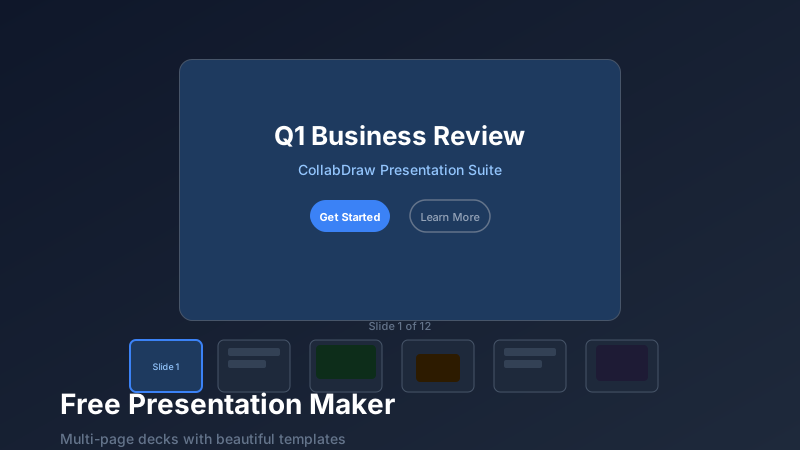
CollabDraw's Pages panel at the bottom of the canvas is the slide manager for presentations. Each page is a canvas of fixed dimensions (you choose the aspect ratio: 16:9, 4:3, A4, or custom).
Pages workflow:
- Add — click "+" in the pages strip to add a new blank slide
- Duplicate — right-click any page to duplicate it with all its content (ideal for consistent slide layouts)
- Reorder — drag pages left or right to reorder slides
- Rename — double-click a page tab to rename it (useful for navigating complex presentations)
- Delete — remove any page you no longer need
What You Can Put on a Slide
Because slides are canvas pages, every CollabDraw canvas element is available:
- Text — headlines, body copy, callouts, captions, with full font and styling control
- Images — uploaded photos, stock images from the built-in 7M+ library, or AI-generated images
- Charts — live bar, line, pie, and donut charts with editable data
- Icons and emojis — 5,500+ icons to support any concept visually
- Shapes — rectangles, circles, arrows, speech bubbles, custom paths
- Tables — data tables with custom cell colours and borders
- Videos — embedded video clips that play during live presentations
- Sticky notes — for workshop and brainstorm slides
Real-Time Team Collaboration on Slides
Multiple team members can work on different slides simultaneously. One person can be refining the title slide while another builds out the data slides and a third formats the closing CTA. All changes appear live on every collaborator's screen.
This parallel workflow cuts presentation build time dramatically compared to the serial handoff process in traditional tools (designer builds, PM edits, designer revises, repeat).
Presenting and Sharing
Live presentation mode
Click "Present" to enter a clean, fullscreen presentation mode. Use arrow keys or keyboard shortcuts to advance slides. The audience sees only your slides — no canvas chrome, no toolbars.
Share as a live link
Share a live link for remote presentations. Your audience opens it in any browser on any device. They see the current slide and can follow along as you advance. No Zoom screenshare lag, no resolution issues.
Export to PDF or PPTX
Export to PDF for client deliverables and documentation. Export to PPTX when stakeholders need to edit the slides further in Microsoft PowerPoint.
Design Tips for Better Presentations
- One idea per slide — if a slide has more than one key message, split it into two
- Less text, more visuals — slides are for visual support, not text transcripts. Your voice carries the narrative.
- Consistent colour palette — use the same 3–4 colours throughout to maintain visual coherence
- Large type — text smaller than 24pt is unreadable at the back of a room or on a small shared screen
- White space is not empty space — breathing room around elements improves focus and reduces cognitive load