
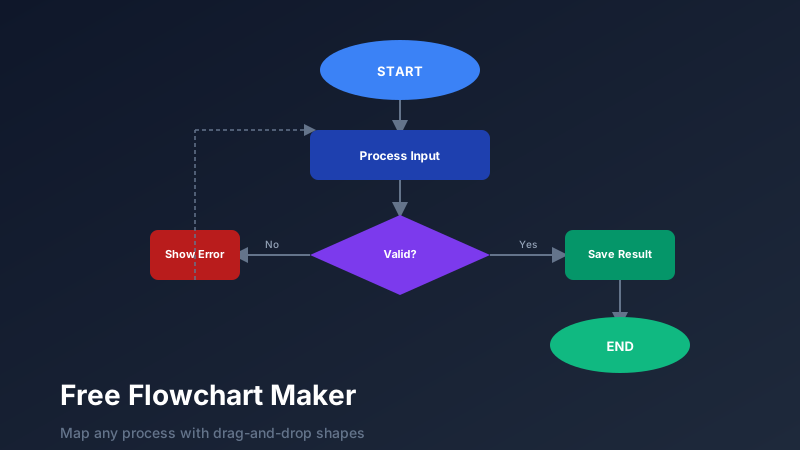
When Do You Actually Need a Flowchart?
Flowcharts solve a specific problem: making a complex process legible to everyone who needs to understand it. You need a flowchart when:
- A business process has multiple branches and exceptions that are hard to describe in prose
- You're onboarding someone new and need to show how a system works
- You're designing a user journey and need to map every decision point
- You're debugging a process and need to see where things break down
- You're presenting a technical system to a non-technical audience
In each case, a well-structured flowchart communicates in seconds what paragraphs of text cannot.
Standard Flowchart Shapes and What They Mean
Professional flowcharts use a standardised visual vocabulary. CollabDraw includes all the standard shapes:
- Oval / Rounded rectangle — Start and End points. Every flowchart has exactly one Start and one or more End nodes.
- Rectangle — Process step. An action that happens: "Validate input", "Send email", "Calculate total".
- Diamond — Decision point. A yes/no or true/false question that branches the flow in two directions.
- Parallelogram — Input/Output. Data that enters or leaves the system: "Read from database", "Print receipt".
- Cylinder — Database or stored data. Represents persistent storage in system diagrams.
- Arrow / Connector — The flow between steps, with optional labels for branch conditions ("Yes", "No", "Error", "Success").
Building a Flowchart in CollabDraw
Step 1: Start with the Start node
Place an oval and label it "Start". This anchors your diagram and reminds you where the process begins.
Step 2: Map the happy path first
Add rectangle process steps for the most common, successful path through the process. Don't worry about exceptions yet — get the core flow right first.
Step 3: Add decision points
Where the process branches based on a condition, insert a diamond. Label the diamond with the question being asked. Add "Yes" and "No" (or your specific condition labels) to the connecting arrows.
Step 4: Handle exceptions and error paths
Now add the alternative branches — error handling, edge cases, exceptional flows. These often loop back to earlier steps ("try again") or route to a separate error endpoint.
Step 5: Add End nodes
Every branch should terminate at an oval labelled "End" (or a more descriptive label like "Success", "Error", "Cancelled").
Smart Connectors in CollabDraw
CollabDraw's connectors are intelligent. When you move a shape, all connectors attached to it move with it and reroute automatically. You never need to manually redraw arrows after reorganising your diagram — a significant time-saver when iterating on complex process maps.
Connectors can be styled as solid, dashed, or dotted lines, with optional arrowheads at one or both ends. Labels can be added to any connector mid-span.
Common Flowchart Types
User Journey Maps
Map every touchpoint a user encounters from first awareness to conversion or churn. Include decision points (does the user see the feature? Do they use it? Do they return?) and annotate with data if available.
System Architecture Diagrams
Show how data flows between system components — frontend, backend, database, external APIs. Use different shape styles to distinguish component types.
Incident Response Playbooks
Map the decision tree for handling production incidents: "Is the service down? → Yes → Page on-call engineer → Is it a database issue? → ..." Flowcharts turn reactive, chaotic incidents into structured, repeatable responses.
Approval Workflows
Document multi-step approval chains: who approves what, what happens if they reject, what escalation path applies. Makes compliance requirements visual and auditable.
Collaborate on Flowcharts in Real Time
Share your flowchart with a link and your team can edit it simultaneously. Useful for workshops where multiple people contribute different sections of a process — one person maps the happy path while another documents the error cases.